 Mini Football Games
How to play Football Bingo
Football Bingo gives you a card of sixteen category squares: clubs, nations, positions and combinations like a nation plus a club. Players are then dealt one at a time, twenty-four in total. If the dealt player fits a square, tap it to place them. If they fit nothing, pass. But be careful: tapping a square the player does not fit throws the player away and costs you the turn. Complete rows, columns and diagonals to make lines, and use your one wildcard to place any player anywhere.
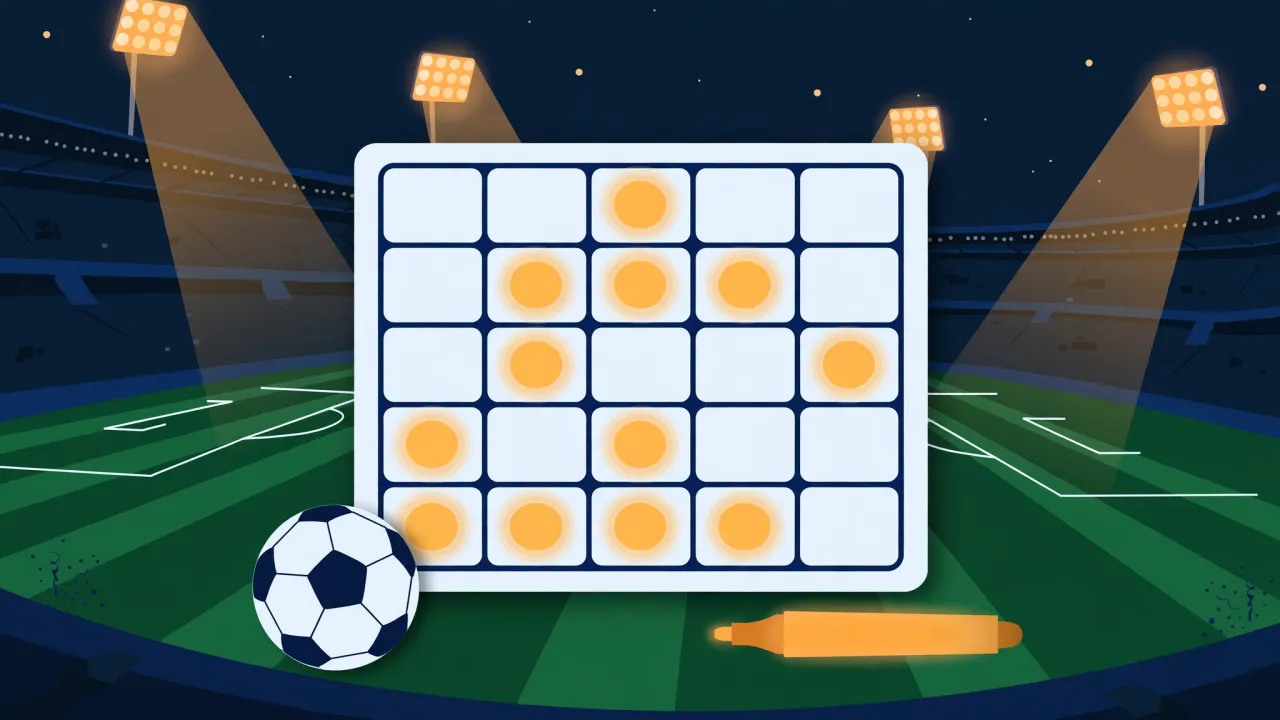
A worked example
Your card has a combination square, a French player at one specific club, sitting in the middle of a row that is otherwise plain clubs and nations. That square is the bottleneck: maybe three of the twenty-four dealt players can fill it. So the first time a French player from that club is dealt, they go there, even if they could also fill the easier French square beside it. Easy squares fill themselves eventually; bottlenecks do not.
Midway through, a dealt superstar fits two open squares, one on a nearly complete column and one on an empty row. The column is the better home: finishing a line changes the game state, and the empty row still has a dozen deals to find its player. Bingo rewards completing things, not tidying things.
The wildcard is for the endgame. With four deals left and one square breaking two lines, an ordinary player who fits nothing else is still gold if the wildcard is unspent: arm it, place them, and take both lines at once. Spent early on a square that would have filled anyway, it is just a normal placement with a fancy name.
The rules in short
- Look at the card: sixteen category squares in a 4 by 4 grid.
- A player is dealt. If they fit any empty square, tap that square to place them there.
- If the player fits nothing, press Pass and take the next deal.
- Tapping a square the player does not fit loses the turn: the player is discarded and the next one is dealt.
- You have one Wildcard per game: arm it, then tap any square to place the dealt player there whatever the category.
- After 24 deals the game ends. Complete at least two lines to win; filling all sixteen squares is a full house.
Scoring
Complete a line (any row, column or diagonal) for each set of four. Two or more lines by the end of the 24 deals is a win, and a full house completes all ten lines at once. Every card is generated with a checked guarantee: the dealt 24 always contain sixteen players who can fill the whole card between them, so a full house is always possible with perfect placement.
Common mistakes
- Spending a flexible player on the first square they fit instead of the hardest one.
- Tapping a square to test it: a wrong placement discards the dealt player and costs the turn.
- Passing a player who fits a combination square because a plain square also fits them.
- Forgetting how many deals remain, and playing the last six cards like the first six.
Strategy tips
- Place flexibly. A player who fits two squares belongs on the one fewer future players can fill, usually a combination square.
- Keep the wildcard for a stubborn square near the end, not for an easy one early.
- Count your deals. With six deals left and three squares open, pass only players who fit nothing at all.
- Combination squares are the bottlenecks: when a player fits one, think hard before spending them on a plain club square.
Modes and variations
The cells mix plain clubs and nations with positions and nation-plus-club combinations, so no two daily cards play the same. Archive cards replay past deals without affecting your streak, and the wildcard is always exactly one per game.